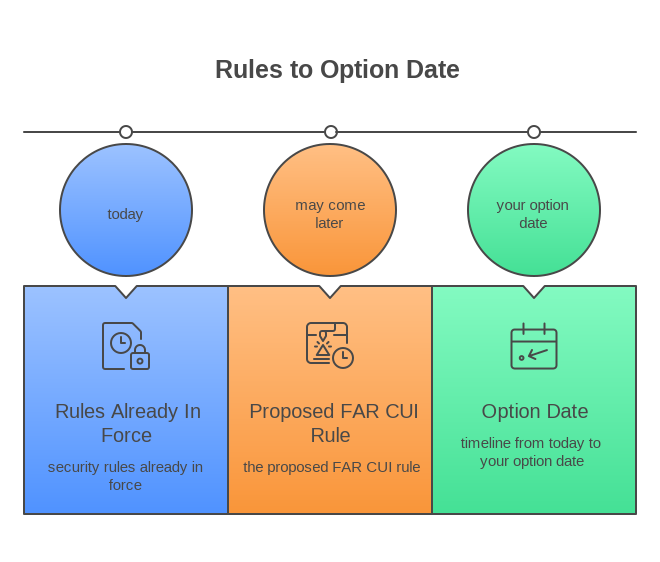
If your GSA Schedule option exercise is coming up, check your security basics now. Most of what you need is already in your contract, and a proposed CUI rule could add more later.
GSA Ready Now, powered by Capital Cyber in Leesburg, Virginia, helps GSA Schedule contractors handling Controlled Unclassified Information (CUI) meet NIST SP 800-171 Rev 3.
At a FAR 2.0 seminar on November 13, the Fort Meade Alliance pointed to the long-pending FAR CUI rule. It is still a proposal. It is not a rule in force.
What happens in a GSA Schedule option exercise year?
A GSA Multiple Award Schedule contract has a base period and option periods. Before each new period, GSA decides whether to exercise the option.
The review focuses on your contract standing. That includes your sales, your pricing, and whether your records and registrations are current.
Think of it as a checkpoint. It is a good time to make sure you meet the terms you already agreed to.
Does GSA audit my cybersecurity before it renews my Schedule?
The option review is not a formal cyber audit. There is no civilian security certificate you must show to renew.
Your contract still contains security clauses, though. If you are not meeting them, that is a risk now, whether or not anyone checks this year.
Which security rules already apply to my Schedule contract?
Several FAR clauses are in force today for civilian contracts. Check whether each one appears in your contract or task orders.
- FAR 52.204-21 sets basic safeguarding rules for Federal Contract Information (FCI). FCI is non-public information you receive or create under a government contract.
- FAR 52.204-23 bans Kaspersky products in contract work.
- FAR 52.204-25 bans certain telecom and video surveillance gear, often called the Section 889 rule.
- FAR 52.204-27 bans TikTok on devices used for federal contract work.
- FAR 52.204-30 requires you to check SAM.gov for supply chain orders that bar certain products.
Some task orders go further. If a task order says you will handle Controlled Unclassified Information (CUI), its terms may already require NIST SP 800-171. Read each order closely.
What is the FAR CUI rule, and is it in force yet?
The FAR CUI rule was published as a proposed rule in January 2025. It would set one standard way for civilian agencies to tell contractors how to handle CUI.
It is not final. Its final details are not settled, including which NIST revision it will point to and when it would take effect.
Do not treat it as a current requirement. Treat it as a signal of where civilian rules may go.
What should I check before my option date?
Work through this list a few months before the option date. Each item is something you can do now.
- Renew your SAM.gov registration and review your representations and certifications.
- Confirm your Section 889 answers are still true for your phones, cameras and network gear.
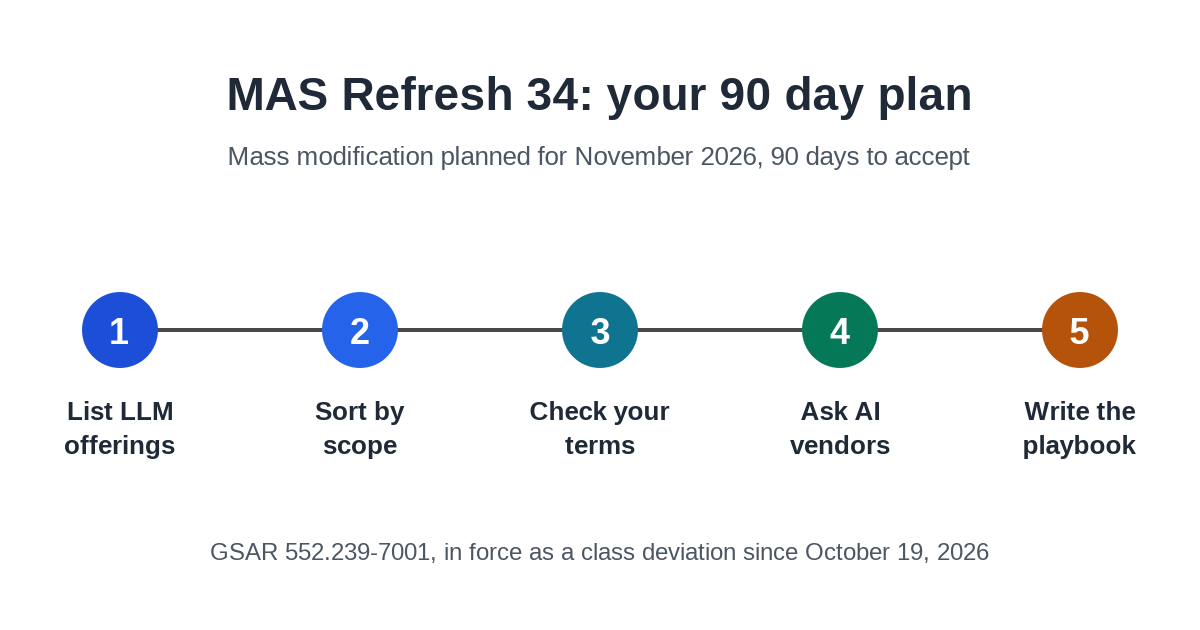
- Accept any open mass modifications, and read the clauses each one adds.
- Check your FAR 52.204-21 basics: who has access, strong passwords, patching, malware protection and safe disposal of old drives.
- Remove any banned software or apps from work devices.
- Search SAM.gov for supply chain exclusion orders that touch your products.
- List every place CUI lives in your business, if any task order involves CUI.
- Do a gap check against NIST SP 800-171 Rev 3, and write a plan for each gap.
NIST published Rev 3 in May 2024. If no contract requires a specific revision yet, it is a sound guide for your own planning.
Do I need CMMC or a certification for civilian work?
No. CMMC is a Department of War program for defense contracts. It does not cover your civilian Schedule work unless you also hold defense contracts.
Much of the CUI content online, including talk about which NIST revision to use, is written for defense firms. Defense rules have their own timeline.
There is no civilian certification for NIST SP 800-171. Be wary of anyone who offers to sell you one.
Frequently Asked Questions
Will GSA check my cybersecurity during the option exercise?
No formal cyber audit is part of the option review. GSA looks mostly at your contract standing, such as sales, pricing and current records. You still must meet the security clauses already in your contract and task orders, so the option year is a smart time to confirm them.
Is the FAR CUI rule a requirement now?
No, the FAR CUI rule is still a proposed rule. It was published for comment in January 2025 and is not final. Its final terms and start date are not settled. Watch for updates, but do not treat it as a current obligation.
Should I use NIST SP 800-171 Rev 2 or Rev 3?
Follow whatever revision your contract or task order names. If none is named, Rev 3 is the current NIST version and a sound guide for planning. Defense contracts follow their own rules, so do not copy defense guidance into civilian work.
What does this mean for my business?
It means your option year is a good time for a security check. Confirm the FAR clauses already in force, clean up SAM and banned products, and map any CUI you hold. That work protects you now and prepares you if the proposed CUI rule becomes final.
Sources
- NIST SP 800-171 Rev 3
- FAR 52.204-21 Basic Safeguarding of Covered Contractor Information Systems
- FAR 52.204-23 Kaspersky Lab prohibition
- FAR 52.204-25 Telecommunications and video surveillance prohibition
- FAR 52.204-27 Prohibition on a ByteDance covered application
- FAR 52.204-30 FASCSA orders
- National Archives CUI Program
- GSA Multiple Award Schedule
- SAM.gov
- Fort Meade Alliance FAR 2.0 seminar post
Want a second set of eyes on the CUI terms in your GSA Schedule contract or task orders? Talk to the GSA Ready Now team.
Talk to a Compliance Specialist