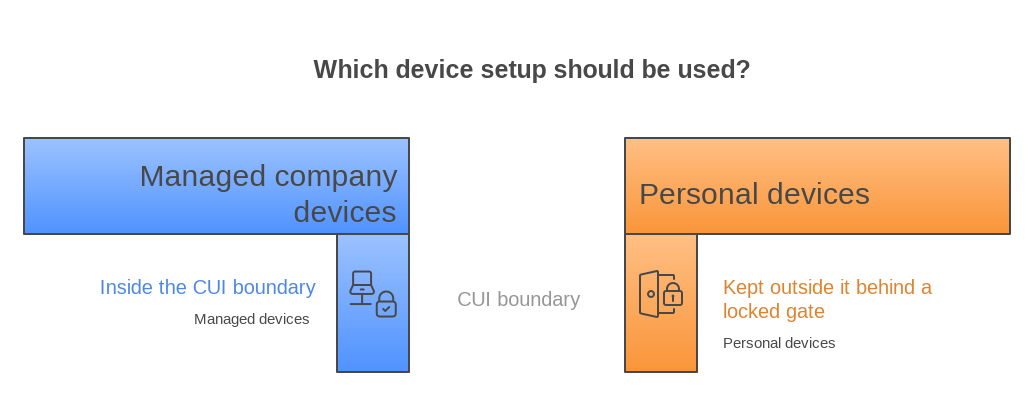
If your team handles CUI on personal devices, those phones and laptops become part of what you must protect. The simplest fix is to choose which devices may touch CUI and keep the rest out.
GSA Ready Now, powered by Capital Cyber in Leesburg, Virginia, helps GSA Schedule contractors handling Controlled Unclassified Information (CUI) meet NIST SP 800-171 Rev 3.
This week, GSA's Office of Inspector General released an audit of how the Public Buildings Service oversees electronic contract files. The report cites Executive Order 13556, the order that created the CUI program. Electronic files move easily, and they can land on any device that opens them.
What counts as CUI on a laptop or phone?
CUI is unclassified information that still needs safeguarding or limits on sharing. The National Archives keeps the official list of CUI categories.
On a device, CUI can hide in many places:
- Email attachments from a contracting officer
- Drawings, floor plans or building data
- Contract files synced to a cloud folder
- Photos, screenshots and downloads
- Texts or chat messages that quote CUI
If a device can open, store or forward any of these, you need to protect it.
Do civilian contractors have to follow NIST SP 800-171 today?
It depends on your contract. Today, your duties come from the clauses and terms in each agreement. Read them closely.
Federal rules at 32 CFR Part 2002 tell agencies to use NIST SP 800-171 for CUI on contractor systems. That rule binds agencies. Many pass it to contractors through contract language.
The FAR CUI rule, FAR Case 2017-016, was proposed in January 2025. It is still a proposal, not a rule in force. Its final form and timing are not settled.
CMMC is a Department of War program for defense contracts. It does not cover your civilian work. There is also no civilian CUI certification to earn.
Can my team keep CUI on personal devices?
They can, but it is the hardest path to defend. A personal phone holds apps and accounts you do not control. Proving CUI stays safe there is difficult.
Most small firms choose one of three options:
- Ban CUI on personal devices. Only company laptops and phones may touch it.
- Allow personal phones only through a managed work app that walls CUI off.
- Allow web access only, with downloads, copying and printing turned off.
Option 1 is the easiest to explain to an agency. Option 2 needs mobile device management software. Option 3 depends on how your cloud tools are set up.
What does NIST SP 800-171 Rev 3 expect from laptops and phones?
NIST published Rev 3 in May 2024. Several requirements apply directly to devices:
- Mobile device access (03.01.18): control which mobile devices connect, and encrypt CUI on them.
- External systems (03.01.20): limit use of systems you do not own, like personal devices.
- Device lock (03.01.10): lock screens after a set idle time.
- Remote access (03.01.12): control and monitor remote connections.
- High risk areas (03.04.12): set up devices with extra care before risky trips.
- Cryptographic protection (03.13.11): use the encryption you define to protect CUI.
Rev 3 lets you set many details yourself, like idle times. Write those choices down.
If the FAR CUI rule becomes final, which revision it will require is not settled. Rev 3 is the current NIST version, so it is a sound target.
What should a small contractor do this month?
- List every laptop and phone that touches CUI.
- Pick your policy: ban, managed app or web only.
- Turn on full disk encryption on every company laptop.
- Set screen locks and strong passcodes on every phone.
- Remove CUI from any device outside your policy.
- Write the policy down and have staff sign it.
- Add these devices to your system security plan.
Frequently Asked Questions
Is CUI classified information?
No, CUI is unclassified. It still needs safeguarding or limits on who can see it, as defined in Executive Order 13556. Handling rules come from the CUI program and your contract, not from classification rules.
Is the FAR CUI rule in effect?
No, the FAR CUI rule is still proposed. It was published for comment in January 2025 as FAR Case 2017-016. Until a final rule is issued, your duties come from your current contract terms.
Does CMMC apply to my GSA Schedule contract?
Not by itself. CMMC is a Department of War program tied to defense contracts. If you also hold defense work, those contracts may carry CMMC terms. Your civilian contracts follow their own clauses.
Can I get certified for NIST SP 800-171 on the civilian side?
No civilian CUI certification exists today. You can still assess yourself against NIST SP 800-171 Rev 3 and keep good records. Those records help when an agency asks how you protect CUI.
What does this mean for my business?
Every phone and laptop that touches CUI needs a clear rule. Decide which devices are allowed, encrypt them and keep the rest out. That work holds up under your current contracts and under any future rule.
Sources
- NIST SP 800-171 Rev 3
- 32 CFR Part 2002, Controlled Unclassified Information
- National Archives CUI Program
- GSA OIG, PBS Should Improve Its Oversight of Electronic Contract Files
- DCSA post on the proposed FAR CUI rule
- On-Site Technology, FCI vs CUI for Federal Contractors
Want a second set of eyes on the CUI terms in your GSA Schedule contract or task orders? Talk to the GSA Ready Now team.
Talk to a Compliance Specialist