
If you hold a GSA schedule contract, GSA eBuy is the platform where a significant portion of your federal sales opportunity lives. Agencies post Requests for Quotations (RFQs) to schedule holders, and contractors who respond consistently and well win a disproportionate share of task orders. This guide walks through how eBuy works, how to set yourself up for visibility, and what separates responses that win from responses that get ignored.
What Is GSA eBuy and How Does It Work?
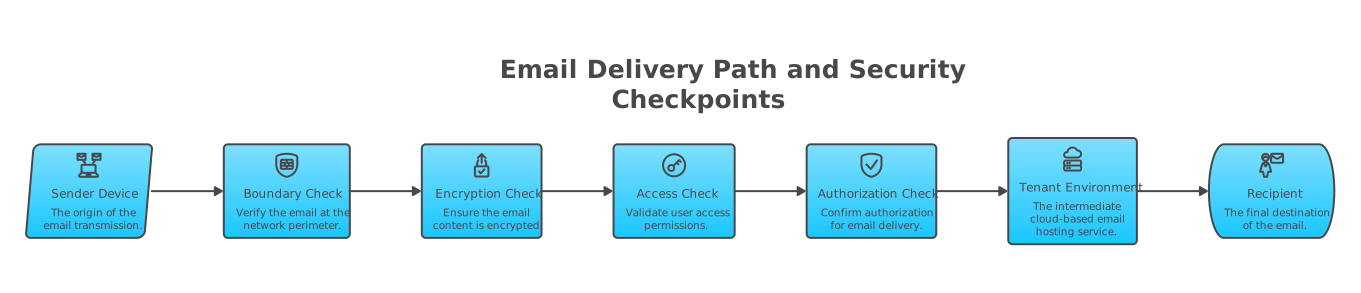
GSA eBuy is an online platform that allows federal agencies to post RFQs directly to schedule contract holders. When a contracting officer has a requirement, they can search for relevant vendors, select those with applicable SINs, and issue a solicitation. Only schedule contractors with the matching Special Item Numbers receive the RFQ.
Unlike public solicitations on SAM.gov, eBuy RFQs are targeted. The contracting officer chooses which schedule holders to invite. This is why your catalog accuracy and SIN selection matter so much: if your offerings are not properly categorized, you will not see solicitations in your space. Our overview of the GSA First policy explains why eBuy visibility is now central to federal sales for schedule holders.
How Do You Set Up for Maximum Visibility on GSA eBuy?
Before you start monitoring eBuy, make sure your foundation is solid:
- Keep your GSA Advantage! catalog current. Contracting officers often search GSA Advantage before posting an eBuy RFQ. Accurate descriptions, current pricing, and complete product data improve your chances of being included in the invite list.
- Set up RFQ email notifications. Log into eBuy and configure alerts for each of your SINs. Without alerts, you will miss solicitations with short response windows.
- Verify your SIN coverage. Review whether the SINs on your contract accurately reflect your full range of services. Gaps in SIN coverage mean missed solicitations.
How Do You Find the Right RFQs to Respond To?
eBuy delivers a mix of opportunities: some are well-aligned with your capabilities and others are not. Responding to everything is not a strategy. Filter by what actually fits:
- Dollar value: Focus on opportunities where you can be genuinely competitive. Very small orders may not justify the response effort, while very large orders may favor incumbents with stronger past performance.
- Agency fit: Some agencies are better long-term customers than others. Build familiarity with agencies whose missions align with your capabilities.
- Scope alignment: Read the statement of work before investing time in a response. If the requirement strays from your core competency, a weak response hurts more than not responding.
- Response deadline: Short windows, under 48 hours, may signal the agency already has a preferred vendor. Respond only if you can put forward a genuinely competitive quote.
How Do You Write an eBuy Response That Wins?
The quality of your eBuy response directly affects your win rate. A strong response does all of the following:
- 1
Addresses every requirement directly
Read the statement of work carefully and confirm your response touches each item. Agencies receive multiple quotes and non-compliant responses are eliminated quickly.
- 2
Leads with value, not capability
Rather than describing who you are, explain what the agency gets. Outcomes, timelines, and measurable results resonate more than company background.
- 3
Provides a clear, detailed price breakdown
Vague pricing creates questions. Break down your quote by labor category, rate, hours, and direct costs. Transparency builds trust and speeds evaluation.
- 4
References relevant past performance
Even for eBuy responses, a brief mention of a directly comparable completed engagement strengthens your quote. One or two specific examples carry far more weight than general claims. For a full guide on building this record, see our post on past performance for GSA contracts.
- 5
Is submitted before the deadline with time to spare
Late submissions are automatically rejected. Build your response with a buffer, and double-check the time zone specified in the RFQ.
What Are the Most Common eBuy Mistakes?
- Not setting up notifications. If you are not monitoring eBuy actively, you are missing opportunities. Configure SIN-specific alerts and check the platform regularly.
- Responding to everything without prioritization. Volume is not the same as strategy. Put real effort into RFQs where you can be genuinely competitive.
- Copying and pasting boilerplate. Contracting officers read many quotes. Generic responses that do not address the specific requirement stand out negatively.
- Ignoring small orders. Many agencies use small eBuy orders to evaluate new vendors before committing to larger task orders. Winning smaller contracts builds the relationship.
Want to make sure your GSA contract is optimized for eBuy visibility? A free readiness assessment identifies gaps in your catalog, SIN coverage, and compliance posture.
Check Your eBuy ReadinessWhat Should You Do Next About GSA eBuy?
GSA eBuy is one of the most direct paths to federal revenue for schedule contractors. Agencies use it to move quickly, and contractors who respond consistently and well build a steady pipeline of task orders. Keep your catalog accurate, monitor your SINs, and invest time in quote quality. The results compound over time as agencies learn they can count on your responses.